
MedicineNet is a legitimate medical information site, part of the WebMD Health network, with genuine credentials in health journalism. Its IQ test has attracted millions of visitors. That combination of institutional respectability and massive reach makes it worth examining carefully rather than dismissing or accepting uncritically.
What MedicineNet is, and what its IQ test is not
MedicineNet’s core business is health and medical content: drug information, symptom checkers, condition explainers. The IQ quiz exists as a content-marketing asset on that platform, not as a psychometric instrument developed by researchers in cognitive assessment.
This distinction matters more than it might seem. A properly validated IQ test requires a norming sample (a large, representative group of people whose scores establish the scale), test-retest reliability data, and evidence of construct validity (proof that the test measures what it claims to measure). The American Psychological Association’s Standards for Educational and Psychological Testing lays out these requirements in detail. MedicineNet does not publish any of this for its quiz, because the quiz was not built to meet those standards.
That is not a scandal. It is just a category error to treat the result as equivalent to a clinical score.
What the MedicineNet quiz actually does well
Fairness requires noting the genuine positives.
It is accessible and low-friction. The quiz is free, short, and requires no registration. For someone who has never thought about cognitive testing and wants a rough first impression, the barrier to entry is essentially zero.
It covers recognisable cognitive domains. The questions touch on pattern recognition, verbal reasoning, and spatial thinking. These are real components of intelligence as psychometricians define it. The quiz is not asking about trivia or pop culture; it is at least pointing in the right direction.
It raises awareness of IQ testing as a concept. Many people who take the MedicineNet quiz will, for the first time, encounter the idea that intelligence can be measured systematically. That is not nothing. Curiosity is a reasonable starting point.
Where the methodology falls short
Here is where the honest accounting becomes less comfortable for the quiz.
No published norming sample
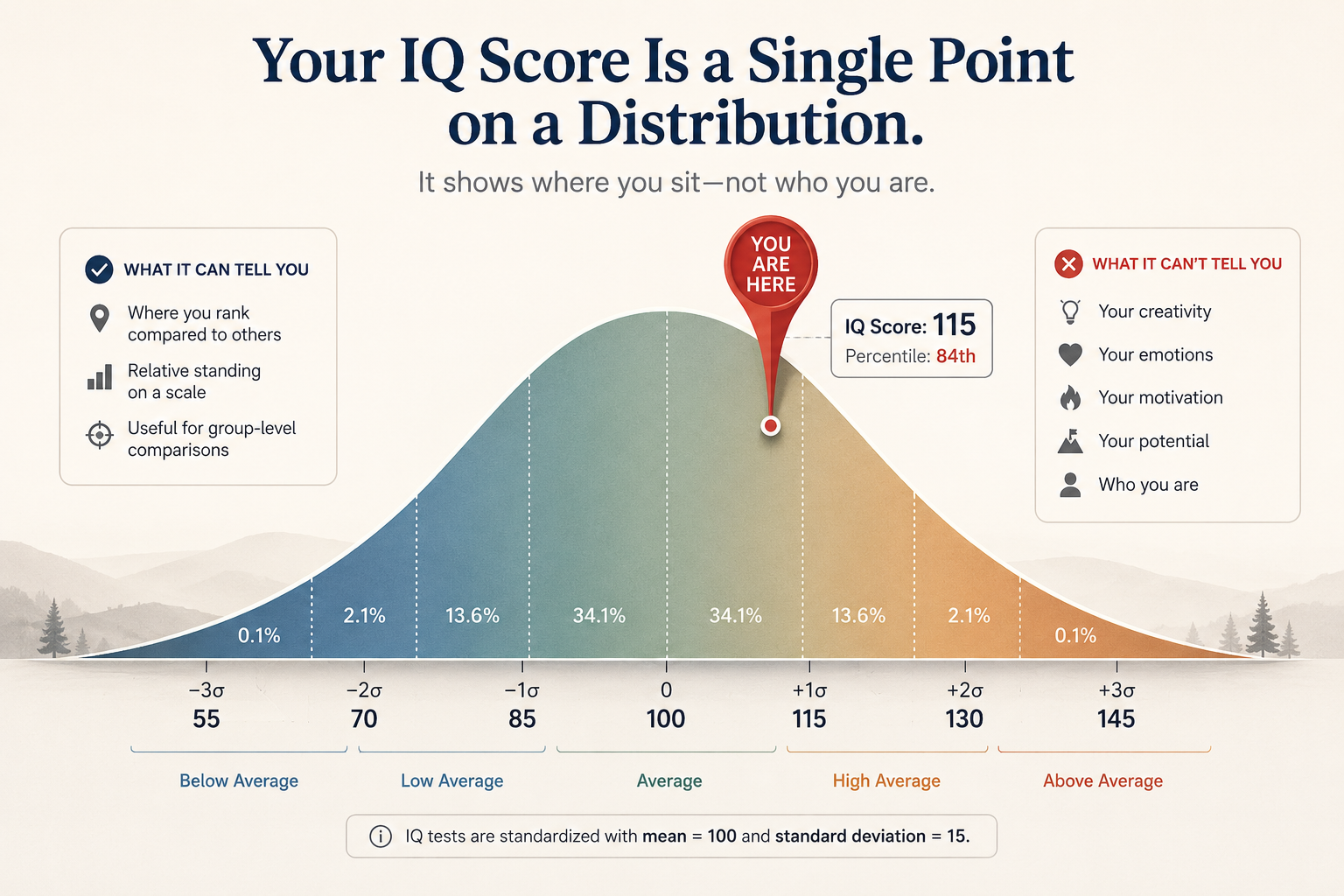
An IQ score is a relative measurement. A score of 115 means nothing in isolation; it means something only because we know the distribution of scores in a reference population. The Stanford-Binet 5, the Wechsler Adult Intelligence Scale (WAIS-IV), and similar instruments are normed on samples of several thousand people, stratified by age, sex, education, and geography to match census data. MedicineNet publishes no such sample. Without it, the number the quiz returns is not an IQ score in any technical sense. It is a raw score mapped to an IQ-shaped output.
No reliability data
A reliable test produces consistent results when the same person takes it at different times (test-retest reliability) and when different versions of the test are compared (parallel-forms reliability). Published clinical instruments report these coefficients explicitly. For the WAIS-IV, full-scale IQ test-retest reliability is approximately 0.96, meaning the score is highly stable across sessions. MedicineNet reports nothing comparable. If you took the quiz on a Monday and again on a Thursday, there is no published evidence about how much your score would vary.
No validity evidence
Does the quiz actually measure general cognitive ability (the g factor that underlies performance across cognitive domains) or something else, like familiarity with a particular style of puzzle? Validity studies answer this question by correlating test scores with external criteria: school grades, job performance, scores on validated instruments. Without such studies, the quiz’s claim to measure intelligence rests on face validity alone, which is the weakest form of evidence in psychometrics.
Short item count
Most versions of the MedicineNet quiz use somewhere in the range of 10 to 15 questions. The WAIS-IV uses 15 subtests totalling several hundred items. Measurement precision in psychometrics is partly a function of item count: more items reduce the influence of guessing and random error. A 10-question quiz has a very wide confidence interval around any score it produces, even if the items themselves were perfectly calibrated (which, again, we cannot verify).
The score you receive: what it probably reflects
If you scored well on the MedicineNet quiz, the most defensible interpretation is that you are reasonably comfortable with the kind of abstract reasoning and pattern-matching that short online quizzes test. This correlates, loosely, with general cognitive ability. But the correlation is loose, the measurement error is large, and the score carries none of the interpretive weight of a clinically normed result.
Psychologists use the term floor and ceiling effects to describe what happens when a test is too easy or too hard for a given population. A short, unvalidated quiz is particularly vulnerable: high scorers may simply be people who are good at this type of puzzle, and low scorers may simply be unfamiliar with the format.
If you scored lower than you expected, this is worth keeping in mind. A short online quiz is not a reliable measure of your cognitive ceiling.
How this compares to other free online options
The landscape of free online IQ tests is wide and uneven. Most share MedicineNet’s limitations: no published norming, no reliability data, no validity studies. Some are worse in additional ways, using items that are culturally specific, poorly translated, or drawn from a single narrow domain.
The honest position is that no free, self-administered online test can replicate the psychometric properties of a clinical instrument. The Stanford-Binet 5 and WAIS-IV are administered by trained psychologists in controlled conditions, with standardised instructions and timing, for reasons that matter to the result. An online quiz cannot control for distractions, motivation, or the assistance of a search engine.
What a well-designed online assessment can do is give you a reasonable, structured estimate of where your performance sits relative to other people who have taken the same test. The key phrase is “relative to other people who have taken the same test.” That is a more limited claim than a clinical IQ score, but it is an honest one. You can read more about what separates a normed instrument from a content quiz in the discussion of what makes an IQ test official.
When a clinical evaluation actually matters
For most people, a free online quiz is a reasonable way to satisfy curiosity. But there are circumstances where the stakes are high enough that a clinical evaluation is worth the cost and time:
- Educational placement decisions for children, where a score may influence access to gifted programmes or learning support.
- Disability accommodations at university or in the workplace, where documentation from a licensed psychologist is typically required.
- Neuropsychological concerns, such as suspected learning disabilities, ADHD, or cognitive decline, where a full battery of tests is needed to distinguish between different profiles.
In these situations, the MedicineNet quiz, or any online quiz, is not a substitute. A licensed clinical psychologist administering a validated instrument is the appropriate standard.
Putting the result in context
The most useful thing you can do with a MedicineNet score is treat it as a prompt rather than a verdict. If the quiz made you curious about your cognitive profile, that curiosity is worth following up. Understanding what IQ scores actually represent, how the scale is constructed, and what the research says about the stability and predictive validity of these measures is genuinely interesting and practically useful. The IQ score scale explained is a good place to start building that understanding.
It is also worth knowing that IQ, even when measured by the best available clinical instruments, is not a fixed ceiling on what you can learn or achieve. The research on this is nuanced: general cognitive ability is relatively stable in adults (test-retest correlations over decades are around 0.70 to 0.80), but it is not destiny. What IQ predicts, and what it does not, is a question the psychometric literature has examined carefully, and the answer is more interesting than either “IQ is everything” or “IQ is meaningless.”
For a broader look at what cognitive tests are actually measuring under the hood, the piece on what intelligence tests actually measure covers the construct validity debate in more depth.
The bottom line
MedicineNet’s IQ quiz is a reasonable piece of content marketing from a reputable health publisher. It is not a psychometric instrument. The score it produces is not an IQ score in the technical sense: it lacks a published norming sample, reliability data, and validity evidence. Taking it is harmless, and for someone with no prior exposure to cognitive testing, it may be a useful introduction to the concept.
But if you want a result that is more carefully calibrated, built on a larger item pool, and honest about what it can and cannot tell you, a more structured online assessment is worth the extra few minutes. You can try the assessment here on this site to see how a structured online test compares in terms of question variety and score interpretation.
FAQFrequently asked questions
Is the MedicineNet IQ test accurate?
MedicineNet's quiz covers some real cognitive domains, but it has no published norming sample, reliability data, or validity studies. This means the score it produces cannot be interpreted with the same confidence as a clinically validated instrument. Treat it as a rough orientation, not a precise measurement.
What is a norming sample and why does it matter for IQ tests?
A norming sample is a large, representative group of people whose scores establish the scale against which your result is compared. Without one, a score of, say, 115 has no meaningful reference point. Validated tests like the WAIS-IV norm on thousands of people stratified by age, sex, and geography.
Can an online IQ test replace a clinical evaluation?
No. Clinical evaluations are administered by trained psychologists under standardised conditions, using instruments with published reliability and validity data. Online tests cannot control for distractions, motivation, or outside assistance, and they lack the depth of a full cognitive battery.
Why do so many free IQ tests exist online if they are not clinically valid?
Free online IQ quizzes are primarily content-marketing tools designed to attract traffic and engagement. They can raise awareness of cognitive testing as a concept, but they were not built to meet the standards the American Psychological Association sets for psychological assessment instruments.



 Secure checkout


