The question behind the question
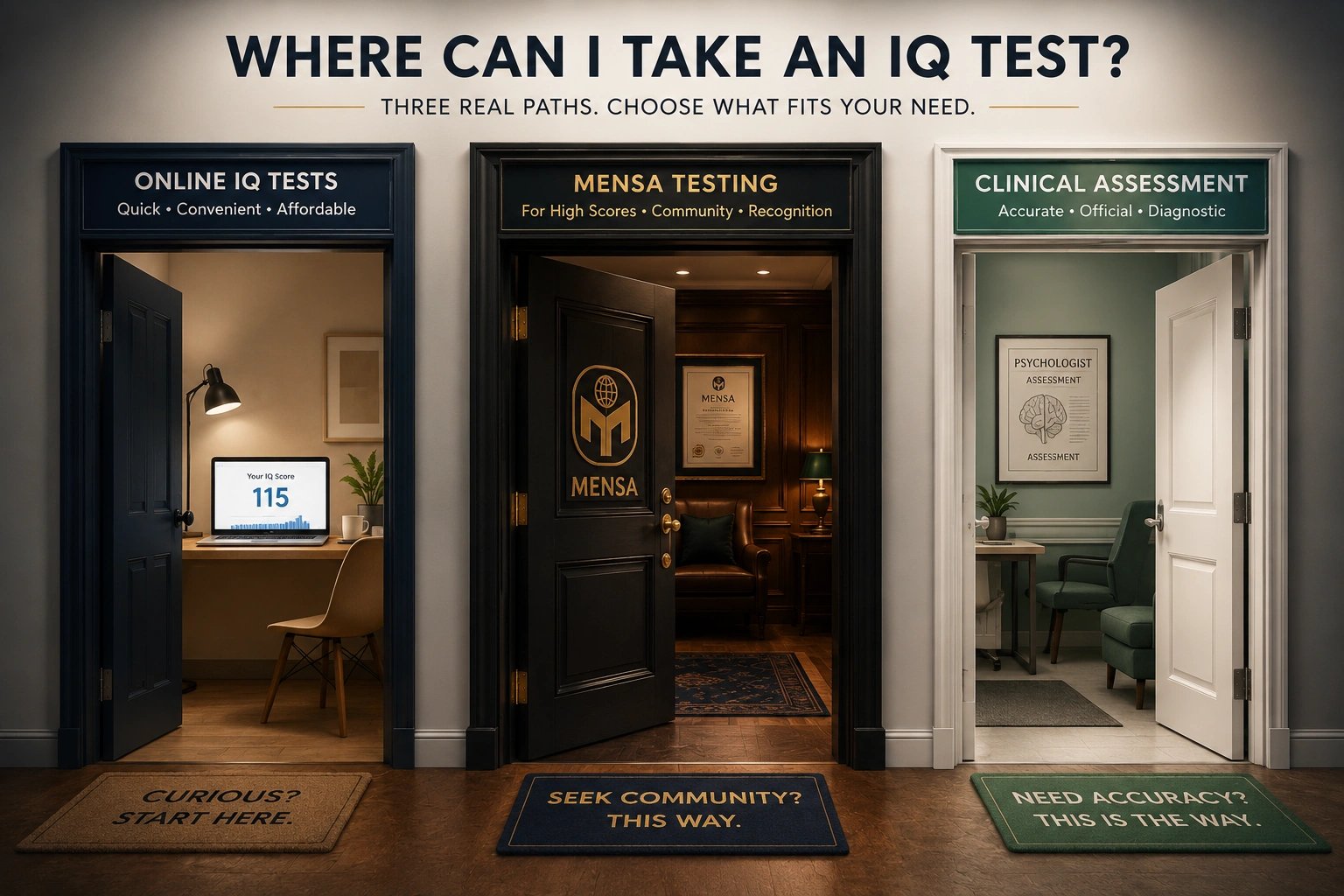
When someone types “where can I take an IQ test,” they usually have one of three very different things in mind. Some want a quick read on how they compare to other people. Some are applying for Mensa or a competitive program and need a defensible score. And some are trying to understand a learning difference, a developmental concern, or a cognitive change that has been worrying them or someone they love.
Those three situations call for three completely different answers. Pointing everyone toward the same website, or the same clinic, is a disservice. So let’s walk through the real options, what each one actually gives you, and how to decide which fits your situation.
Option 1: Free online tests
This is where most people start, and for good reason. Free online IQ tests are instant, zero-cost, and available from dozens of sites. The experience is usually 20 to 40 questions covering pattern recognition, verbal reasoning, and basic logic. You finish, you get a number, and you feel like you learned something.
The honest version of what you learned: you got a rough signal about how your reasoning performs on that particular set of questions, on that particular day, without any of the standardized conditions that make a score comparable across people.
That is not nothing. A well-constructed online test can tell you whether you are likely to find a clinical test interesting or challenging. It can surface genuine strengths and weaknesses in how you approach problems. It can satisfy curiosity.
What it cannot do is produce a score that a university admissions office, an employer, a court, or a clinician will treat as meaningful. The reason is not that the questions are bad. It is that norming is missing. A clinical IQ score is only interpretable because it was calibrated against a large, carefully selected sample of the population. Most free online tests either skip that step entirely or use a self-selected internet sample that skews heavily toward people who enjoy taking IQ tests online. Those are not the same thing.
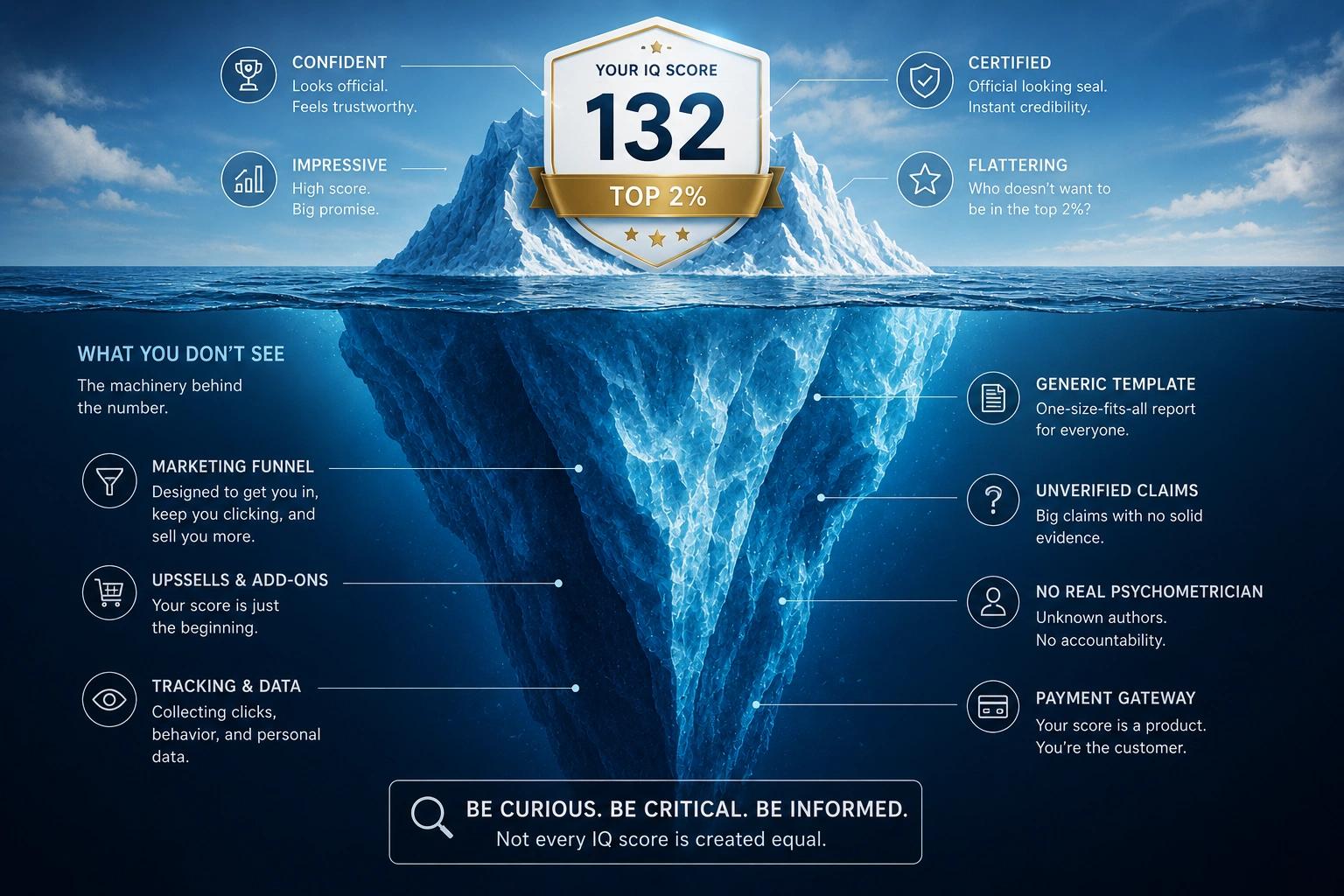
If your goal is curiosity, self-exploration, or a low-stakes benchmark, a free online test is a reasonable starting point. The online IQ test landscape guide on this site goes deeper on what separates a thoughtfully built online test from a score-inflating quiz designed to flatter you into sharing it.
Stanford-Binet Online sits in this category. It is a free, self-administered cognitive assessment available at /online-iq-test/. It is not a clinical Stanford-Binet 5 administration, and it does not produce a score that substitutes for one. What it does offer is a structured, reasonably rigorous set of tasks that give you a genuine sense of where your reasoning sits, without requiring an appointment or a credit card.
Option 2: Mensa’s supervised test
Mensa International is a membership organization for people who score at or above the 98th percentile on a qualifying IQ test. They administer their own supervised test sessions, and they also accept prior scores from a list of approved clinical instruments.
If you want to join Mensa, the path is straightforward: find a local chapter, register for a test session, and sit the supervised exam. The test is proctored, timed, and scored against Mensa’s own norms. A qualifying score earns you membership.
A few things worth knowing before you go:
- Mensa’s test is designed specifically to identify the top 2 percent. It is not a full-spectrum diagnostic tool. It will tell you whether you qualify for Mensa; it will not tell you much about the shape of your cognitive profile across different domains.
- The score Mensa gives you is not transferable. It is a membership qualification, not a clinical report.
- If you already have a qualifying score from an approved test (the Wechsler scales, the Stanford-Binet 5, and several others are on the list), you can submit that instead of sitting Mensa’s own exam.
Mensa’s test is the right choice if and only if Mensa membership is actually what you want. It is not a shortcut to a clinical-quality score, and it is not a substitute for a diagnostic evaluation.
Option 3: Clinical evaluation by a licensed psychologist
This is the gold standard, and it is also the most expensive and time-consuming option. A full psychoeducational or neuropsychological evaluation typically takes four to eight hours of testing spread across one or two sessions, followed by a written report. Costs in the United States generally run from $1,500 to $4,000 out of pocket, though some university training clinics offer sliding-scale rates, and insurance sometimes covers evaluations tied to a specific diagnostic question.
What you get in return is genuinely different from anything else on this list. A licensed psychologist administers a validated instrument (most commonly the Wechsler Adult Intelligence Scale, the WAIS-IV or WAIS-V, or the Stanford-Binet 5) under standardized conditions, scores it against a nationally representative norming sample, and interprets the results in the context of your history, your reported concerns, and any other assessments administered alongside the IQ test.
The score is legally defensible. It can support accommodations requests for standardized exams like the SAT, GRE, LSAT, or bar exam. It can inform an ADHD or learning disability diagnosis. It can document cognitive changes over time. It carries weight in educational placements, disability determinations, and clinical treatment planning.
Who actually needs this level of evaluation? Roughly speaking:
- Anyone seeking accommodations for a high-stakes standardized test
- Anyone being evaluated for a learning disability, ADHD, or developmental concern
- Anyone with a neurological condition where tracking cognitive function matters
- Anyone whose score will be used in a legal or employment context
If none of those apply to you, a clinical evaluation is probably more than you need. But if any of them do apply, it is the only option that will actually serve you.
To find a qualified evaluator, the American Psychological Association’s psychologist locator is a reasonable starting point. University psychology departments often run training clinics where doctoral students administer evaluations under licensed supervision, at significantly reduced cost.
Option 4: School or workplace testing
A fourth category exists that many people overlook: testing arranged through an institution rather than sought out individually.
School districts in the United States are legally required to provide psychoeducational evaluations at no cost to families when there is a reasonable suspicion of a disability that affects learning. If you have a child who is struggling and you believe a learning disability or intellectual difference might be involved, you can request an evaluation in writing from the school district. The district must respond within a set timeframe (typically 60 days) and, if they agree to evaluate, must provide a full assessment including IQ testing.
The quality of school-based evaluations varies, and the results are used primarily for educational placement decisions rather than clinical diagnosis. But for families who cannot afford a private evaluation, this is a meaningful option.
Some employers, particularly in fields like military service, law enforcement, and certain government roles, administer cognitive ability tests as part of hiring. These are not IQ tests in the clinical sense, but they draw on similar underlying constructs. If you are preparing for one of these, practicing on a free online test can help you get a feel for the format.
Matching the option to the goal
Here is the decision logic in plain terms:
If you are curious about your cognitive profile and want a structured, free way to explore it: a well-designed online test is the right fit. Understand that the score is a signal, not a clinical measurement, and treat it accordingly.
If you want to join Mensa: take Mensa’s supervised test or submit a qualifying score from an approved clinical instrument.
If you need a score that carries real-world weight (accommodations, diagnosis, legal or employment purposes): you need a clinical evaluation from a licensed psychologist. There is no shortcut here, and any site that implies otherwise is not being straight with you.
If your child is struggling in school and you suspect a learning difference: request a school-based evaluation in writing. It is free, and you are legally entitled to it.
The what makes an IQ test official article on this site unpacks the psychometric criteria that separate a valid, standardized test from a score-generating quiz, which is useful background if you are deciding between options. And if you want to understand what any IQ score actually means once you have one, the IQ score scale guide walks through the numbers in plain language.
One more thing: what any score can and cannot tell you
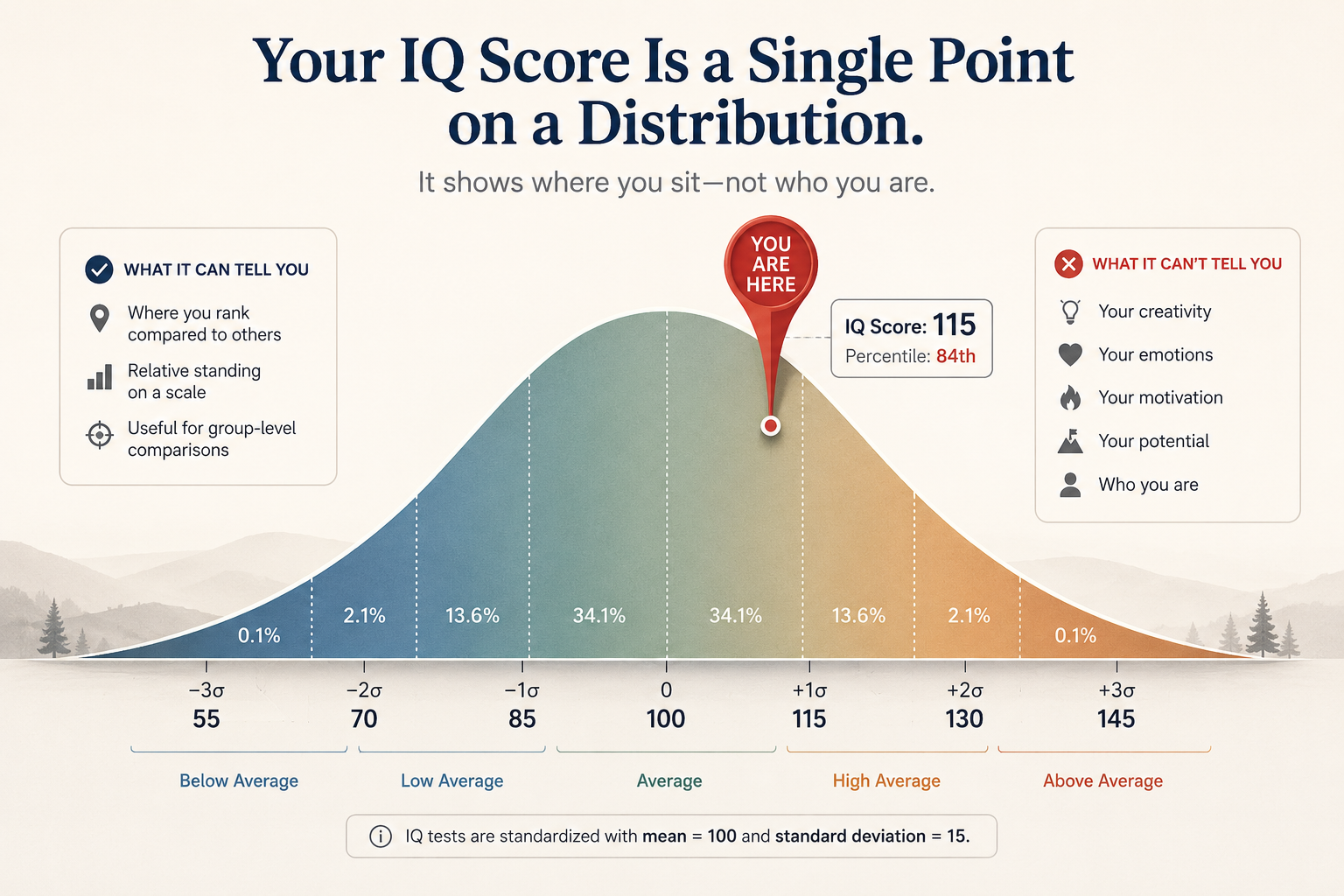
Whichever option you choose, it is worth holding the result lightly. IQ scores are real and meaningful in the sense that they predict certain outcomes better than almost any other single measure. They are also a snapshot, not a fixed ceiling. They reflect performance on a specific set of tasks, on a specific day, under specific conditions.
A score from a free online test is a rough signal. A score from a clinical evaluation is a more precise signal. Neither one is your identity, your potential, or your fate. The what intelligence tests actually measure article goes into the honest limits of what any of these instruments can and cannot tell you, which is worth reading before you put too much weight on any single number.
Ready to get a baseline sense of where you stand? You can take the free cognitive assessment on this site anytime, no appointment needed. Just go in knowing what it is: a thoughtful starting point, not a clinical verdict.
FAQFrequently asked questions
Can I take an IQ test for free?
Yes. Many websites offer free online IQ tests, and this site's cognitive assessment is also free. Keep in mind that free online tests do not produce clinically validated scores, so they are best used for curiosity and self-exploration rather than official purposes.
How do I get an IQ test for official purposes like exam accommodations?
You need a clinical evaluation from a licensed psychologist. The resulting report, based on a validated instrument like the WAIS or Stanford-Binet 5, is what universities, testing bodies, and courts actually accept. A free online score will not substitute for this.
Does Mensa administer its own IQ test?
Yes. Mensa runs supervised test sessions through local chapters. They also accept qualifying scores from a list of approved clinical instruments if you have already been tested by a licensed psychologist.
How much does a clinical IQ evaluation cost?
In the United States, private evaluations typically run from $1,500 to $4,000 out of pocket. University training clinics often offer reduced rates, and some insurance plans cover evaluations tied to a specific diagnostic question.
Can my child get an IQ test through their school?
If there is reasonable suspicion of a learning disability or developmental difference, US school districts are legally required to provide a psychoeducational evaluation at no cost to the family. You can initiate this by submitting a written request to the district.




 Secure checkout


